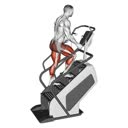
How do you perform this exercise?
Set up
- Set the saddle so your knee stays slightly bent when a pedal is at its lowest point.
- Sit tall, feet on the pedals and one hand on each handle.
Pedalling
- Start at an easy pace for a few minutes to warm up.
- Push one handle away as the leg on the same side pushes its pedal down, and pull the other handle back.
- Keep your back upright and your hips still on the saddle.
- To speed up, push and pull harder: the fan adds resistance by itself.
Finishing
- Slow down gradually for two or three minutes after your last effort.
- Stop the pedals with your feet before you step off.
Common mistakes
Starting an interval flat out
Why: The fan rewards effort instantly, so the first seconds feel easy and you burn out halfway.
Fix: Build to your target pace over the first few seconds and hold it to the end of the interval.
Leaving the arms passive
Why: Hands resting on the handles turn it into a leg-only bike and lower the effort.
Fix: Push and pull the handles actively, in rhythm with the pedals.
Rocking on the saddle
Why: When you push hard, the hips slide and the upper body twists from side to side.
Fix: Sit tall, brace your trunk and keep the effort smooth from both sides.
Tips
- Set the seat so your knee keeps a slight bend at the bottom of the pedal stroke, never fully locked.
- Push and pull the handles actively to bring your upper body in, rather than just resting your hands on them.
- Keep your weight spread through the whole foot; if your toes go numb, relax your grip on the pedals and move your feet slightly.
- For intervals, alternate 30 to 60 seconds of hard effort with easier recovery periods.
How many sets and reps?
| Goal | Rounds | Duration | Rest |
|---|---|---|---|
| IntervalsHard efforts with arms and legs, easy pedalling in between. | 6–10 | 20–30 s | 1–1'30 |
| EnduranceA steady pace at which you can still talk in short sentences. | 1 | 15–30 min | None |
How do you track it in STARK?
- Riding before lifting? Log it as a warm-up set with the flame so it stays out of your working volume.
- For intervals, log each hard effort as a set of one rep and let the rest timer count the easy pedalling.
- On Apple Watch, log each effort and follow the recovery from your wrist without stopping the pedals.
- Air bikes vary between brands, so add the one you use as a machine in STARK.
Frequently asked questions
What muscles does the fan bike work?
Main muscle: cardiovascular system. Secondary muscles: quadriceps, hamstrings and glutes.
Is a fan bike good for beginners?
Yes, it is low impact and the seat takes load off the joints and balance, which makes it accessible for most people. You control the intensity entirely through how hard you push and pull, since the fan adds resistance by itself.
Does the fan bike work the arms too?
Only if you push and pull the handles with intent. It then involves the chest, back and arms lightly, but it remains mainly a cardio exercise for the legs and heart rather than strength training for the arms.
How long should a fan bike session last?
For general cardio, 20 to 45 minutes at a pace where you can still speak in short sentences is a solid base. Short, hard interval sessions also suit the fan bike very well. Build up gradually if you are new to cardio.
What are the alternatives to the fan bike?
Close alternatives: walking on stepmill. Their sheets are further down this page.
STARK · Updated October 26, 2026. Demonstration: ExerciseDB. Description, steps, mistakes, sets and reps, tips and questions written by STARK. Related movements are options to compare, not equivalent loads or a prescribed progression.