How do you perform this exercise?
Set up
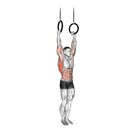
- Set the rings so you can hang with straight arms and your feet just off the floor.
- Take a false grip: the base of your palm over the ring, wrists bent, so your hands can turn over the rings.
- Hang with your body tight, legs together and slightly in front of you.
Pull
- Pull the rings hard toward your lower chest, elbows driving down and close to your body.
- Lean your shoulders back slightly as you pull, so the rings travel toward your hips.
Transition
- As the rings reach your lower chest, snap your chest forward over your hands.
- Bring your elbows up behind you so you land in the bottom of a dip, rings by your ribs.
Dip and finish
- Press up out of the dip until your arms are straight and you support yourself above the rings.
- Lower back through the dip, then through the pull to a hang, under control.
- Breathe at the top or in the hang, never during the transition.
Common mistakes
Pulling to the chin like a pull-up
Why: The rings stay in front of the face and there is no room to turn over.
Fix: Pull lower, toward your sternum and hips, with your body leaning back a little.
Losing the false grip
Why: The hands slide around the rings during the pull and cannot turn over.
Fix: Reset the grip before every rep. Practise false-grip hangs and pull-ups on their own.
One arm turning over first
Why: A stronger side goes through and the other gets stuck below the rings.
Fix: Keep the rings close and turn both hands at the same time. Banded reps help you learn the timing.
Dropping out of the support
Why: After the dip, you let go and fall into the hang.
Fix: Lower slowly through the dip and the pull. The controlled lowering also builds the transition.
Tips
- Build the basics first: strict pull-ups to the chest and deep, strong ring dips are the foundation for a clean ring muscle-up.
- Use a false grip, with the base of your palm over the ring, to make the transition from pull to push much easier.
- Pull the rings toward your lower chest and hips, not your chin, so your body can rotate over them.
- Practise the transition on low rings with your feet on the floor, or with a band, before chasing full reps.
How many sets and reps?
| Goal | Sets | Reps | Rest |
|---|---|---|---|
| Learning the transitionWith a band or feet on the floor, low rings, focus on turning over. | 4–5 | 3–5 | 2 min |
| Skill practiceClean singles or triples, stop when the reps slow down. | 4–6 | 1–3 | 2–3 min |
| EnduranceOnce clean reps are consistent, 1 to 2 reps short of failure. | 3 | 3–6 | 3 min |
How do you track it in STARK?
LoadingBody weight
One side at a time
Previous: 2 × 0 lbsResume
Previous: 2 × 0 lbsResume
Previous: 1 × 0 lbsResume
Previous: 1 × 0 lbsResume
Previous: 1 × 0 lbsResume
+ Add a set- Log each clean rep with 0 kg; the weight column holds only added load, such as a vest.
- Count only full reps, from a hang to a straight-arm support. Banded or feet-assisted reps are better logged as their own exercise.
- You can add a separate exercise for your transition drills so your history shows the real muscle-ups apart.
- Each set shows your previous performance with a button to resume it.
- Start the rest timer from the set: long rests keep every rep clean.
- Your history shows your volume session by session, which shows the skill building.
Frequently asked questions
What muscles does the ring muscle up work?
Main muscle: lats. Secondary muscles: biceps, triceps, shoulders and chest.
How many pull-ups do you need before a ring muscle-up?
There is no fixed number, but most coaches look for several strict pull-ups to the chest and solid ring dips. Pulling high and fast matters more than doing many reps to the chin.
What is the hardest part of a ring muscle-up?
For most people it is the transition, the moment you move from pulling to pushing over the rings. A false grip, a high explosive pull and drills with bands or low rings help with it.
Is kipping a muscle-up cheating?
It depends on your goal. A kipping muscle-up is a legitimate skill in many sports, but a strict muscle-up builds more raw strength. Learning the strict version first is usually safer for your shoulders.
STARK · Updated October 26, 2026. Demonstration: ExerciseDB. Description, steps, mistakes, sets and reps, tips and questions written by STARK. Related movements are options to compare, not equivalent loads or a prescribed progression.