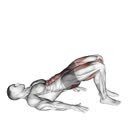
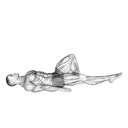
How do you perform this exercise?
Set up
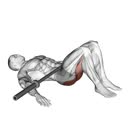
- Sit on the floor with your legs straight and roll a loaded bar, with a pad, up to the crease of your hips.
- Lie back, bend your knees and set your feet flat, hip-width apart, about 30 cm from your buttocks.
- Hold the bar with both hands just outside your hips.
Drive up
- Press through your heels and lift your hips off the floor.
- Keep going until your hips are straight and your weight rests on your upper back and shoulders.
- Keep your knees pointing forward, in line with your feet.
Lowering
- Lower your hips slowly until your buttocks lightly touch the floor.
- Start the next rep without letting the bar rest on you.
Breathing and finishing
- Breathe in at the bottom and breathe out at the top.
- After the last rep, lower your hips fully and roll the bar back down your legs.
Common mistakes
Pushing through the toes
Why: The weight moves to the front of your feet, your heels lift and the quads take over.
Fix: Keep the pressure on your heels; lifting your toes slightly helps.
Knees falling inward at the top
Why: The glutes tire and the knees cave as the hips lock out.
Fix: Push your knees out over your feet and lower the load if they keep caving.
Bar rolling toward your stomach
Why: Without a firm grip, the bar slides up as your hips rise.
Fix: Hold the bar firmly on both sides during the whole set.
Tips
- Use a thick bar pad to protect your hip bones, and keep your upper back and shoulders on the floor so the bar cannot slide toward your stomach.
- Tuck your chin and keep your ribs down so you finish with your glutes, not by arching your lower back.
- Place your feet so your shins are vertical at the top; feet too far out shifts work to the hamstrings.
- Hold the top for a full second with a hard glute squeeze before lowering.
How many sets and reps?
| Goal | Sets | Reps | Rest |
|---|---|---|---|
| Glute growthStop 1 to 2 reps from failure. | 3–4 | 8–12 | 2 min |
| StrengthHeavy and controlled, full lockout on every rep. | 3–5 | 5–8 | 2–3 min |
| Activation before squats or deadliftsLight bar, slow reps. | 2 | 10–12 | 1 min |
How do you track it in STARK?
Load kept: aim for 10 reps. The load will go up after 2 workouts at 10 reps.
LoadingBar
One side at a time
Previous: 9 × 176 lbsResume
Previous: 9 × 176 lbsResume
Previous: 8 × 176 lbsResume
+ Add a set- Set the loading to a bar and log the total, bar included: STARK adds up the plates.
- Mark your warm-up sets with the flame so they stay out of your working volume.
- Each set shows your previous performance with a button to resume it. Count only reps that reach full hip extension.
- STARK keeps the load until you reach your target reps, then tells you when it goes up.
- Your history shows best weight, volume and estimated 1RM for the hip thrust, session by session.
Frequently asked questions
What muscles does the barbell hip thrust work?
Main muscle: glutes. Secondary muscles: hamstrings and lower back.
Where should you feel hip thrusts?
Mostly in your glutes, with some hamstrings and quads. If you feel it mainly in your lower back, you are probably overarching at the top; tuck your pelvis slightly and keep your ribs down. If it is mostly hamstrings, bring your feet a little closer.
Where should the bar sit for a hip thrust?
Across the crease of your hips, just below the hip bones. Roll the bar over your legs with a pad or folded mat, and keep it steady with your hands during the set.
How high should you go on a hip thrust?
Go up until your hips are fully extended, with a straight line from knees to shoulders. Pushing higher only arches your lower back without working the glutes more.
What are the alternatives to the barbell hip thrust?
Close alternatives: glute bridge march and single leg bridge with outstretched leg. Their sheets are further down this page.
STARK · Updated October 26, 2026. Demonstration: ExerciseDB. Description, steps, mistakes, sets and reps, tips and questions written by STARK. Related movements are options to compare, not equivalent loads or a prescribed progression.