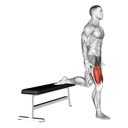
How do you perform this exercise?
Set up
- Stand about a long stride in front of a knee-high bench, facing away from it.
- Place the top of one foot on the bench behind you, laces down.
- Adjust your front foot until you can lower with your torso upright and your front heel flat.
Descent
- Brace and lower your hips straight down by bending the front knee.
- Go down until your back knee is close to the floor and your front thigh is about parallel to it.
Drive up
- Push through your whole front foot to stand back up, the back foot only resting on the bench.
- Straighten the front leg without slamming the knee, then start the next rep.
Breathing and switching legs
- Breathe in on the way down and out on the way up.
- Do all your reps on one leg, then the same number on the other.
Common mistakes
Front foot too close to the bench
Why: A short stance pushes the front knee far forward and lifts the heel.
Fix: Move your front foot forward until the heel stays flat at the bottom.
Pushing with the back leg
Why: The back foot presses into the bench to help, and the front leg does less work.
Fix: Keep the back leg relaxed: you should be able to lift that foot slightly at any moment.
Wobbling sideways
Why: Your two feet are on the same line, as if on a tightrope.
Fix: Place the front foot hip width to the side of the back foot’s line.
Bench too high
Why: A high bench pulls on the front of the back hip and tilts your pelvis forward.
Fix: Use a bench at knee height or slightly lower.
Tips
- Point your toes slightly out and push your knees in the same direction as your toes as you descend.
- Keep your whole foot on the floor; if your heels lift, widen your stance or put small plates under them.
- Let your knees travel forward over your toes if that's natural for you; it puts more work on the quads.
- Slow down the descent or add a pause at the bottom to make each rep much harder before adding weight.
How many sets and reps?
| Goal | Sets | Reps | Rest |
|---|---|---|---|
| Learning the movementHold a support for balance if needed. | 2–3 | 6–8 per leg | 1 min |
| Muscle growthTake three seconds to lower; hold dumbbells once 15 reps are easy. | 3 | 10–15 per leg | 1'30 |
| Strength without equipmentPause two seconds at the bottom and stand up fast. | 3–4 | 6–8 per leg | 2 min |
How do you track it in STARK?
LoadingBody weight
One side at a time
Previous: 9 × 0 lbsResume
Previous: 9 × 0 lbsResume
Previous: 8 × 0 lbsResume
+ Add a set- Turn on “One side at a time” and log the reps of one leg per set.
- Leave the weight at 0, or enter the weight of one dumbbell when you hold a pair.
- Each set shows your previous performance; beat it by one rep per leg at the same depth.
- STARK keeps the load until you reach the target reps, then tells you when it goes up.
- Start the rest timer once both legs are done, on your phone or Apple Watch.
Frequently asked questions
What muscles does the bodyweight bulgarian split squat work?
Main muscle: quads. Secondary muscles: hamstrings and glutes.
How deep should you go on a Bulgarian split squat?
Go as low as you can while keeping your front heel down, your back neutral and your front knee in line with your toes. Thigh parallel is a good target; going deeper is fine if your mobility allows.
Is it OK for your knees to go past your toes when squatting?
Yes, for most people. Knees moving forward is natural, especially in an upright squat that targets the quads. What matters more is keeping your heels down and your knees tracking over your feet.
How do I make bodyweight Bulgarian split squats more effective?
Use a slow tempo, pauses at the bottom or more reps. Once bodyweight is easy, holding a dumbbell or kettlebell at your chest or in each hand is a natural next step.
What are the alternatives to the bodyweight bulgarian split squat?
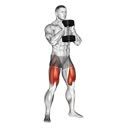
Close alternatives: dumbbell goblet squat. Their sheets are further down this page.
STARK · Updated October 26, 2026. Demonstration: ExerciseDB. Description, steps, mistakes, sets and reps, tips and questions written by STARK. Related movements are options to compare, not equivalent loads or a prescribed progression.