The short answer
Pick one exercise for each job your abs do: bending the trunk (crunch, leg raise), resisting extension (plank, rollout, dead bug) and resisting rotation or side bending (Pallof press, side plank). Do two or three rounds of a five-exercise circuit, two or three times a week, and add reps, time or load as it gets easier. Ab work strengthens the muscles; it does not burn the fat on top of them.
The 8 best ab exercises
Your abs bend the trunk, but most of the time they stop it from moving: arching, twisting or tipping to the side. A complete routine covers both. The exercises below are sorted by job, with a starting dose.
Cable crunch
Trunk flexion · Gym
The most effective way to load the six-pack muscle: you can add weight a little at a time, like any other exercise. Round the back and bring the ribs towards the hips; the hips do not move.
Start with: 3 × 10–15
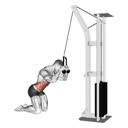
cable kneeling crunch
Abs · Cable
Hanging leg raise
Trunk flexion · Advanced
Works the abs and hip flexors hard over a long range. The goal is to tilt the pelvis up at the top, not just lift the legs; start with bent knees.
Start with: 3 × 8–12
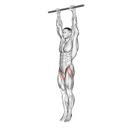
hanging leg raise
Abs · Body weight
Reverse crunch
Trunk flexion · Beginner
The home version of the leg raise: lying on your back, you roll the hips off the floor. Slow and controlled, it is gentler on the lower back than a sit-up.
Start with: 3 × 12–15
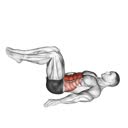
reverse crunch
Abs · Body weight
Ab wheel rollout
Anti-extension · Advanced
Among the exercises with the highest ab activity in Escamilla’s 2006 study. Roll out only as far as you can keep the back flat, then pull back with the abs.
Start with: 3 × 6–10
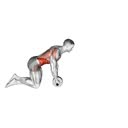
wheel rollout
Abs · Wheel roller
Plank
Anti-extension · Beginner
The base of trunk stability: forearms under the shoulders, body straight, glutes squeezed. Once 60 seconds is easy, add a plate on your back or move on to the rollout rather than holding longer.
Start with: 3 × 30–60 s
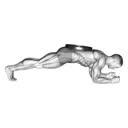
weighted front plank
Abs · Weighted
Dead bug
Anti-extension · Beginner
Teaches you to keep the lower back pressed into the floor while the arms and legs move. A good first exercise, and a safe one if your back is sensitive.
Start with: 3 × 8–10 per side
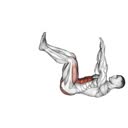
dead bug
Abs · Body weight
Pallof press
Anti-rotation · All levels
Standing side-on to a band or cable, you press your hands forward and refuse to let the trunk turn. It trains the obliques the way they work in sport and daily life.
Start with: 3 × 10 per side
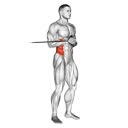
band horizontal pallof press
Abs · Band
Side plank
Anti-lateral flexion · Beginner
Works the obliques and the deep muscles on the side of the trunk. Keep the hips high and the body in one line; start with knees bent if needed.
Start with: 3 × 20–45 s per side
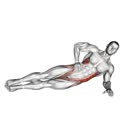
side bridge v. 2
Abs · Body weight
The ab circuits
Do the exercises one after the other with little or no rest, then rest before the next round. Stop a set one or two reps before your form breaks down.
At-home ab circuit (beginner, no equipment)
- Rounds
- 3
- Rest
- 60 s between rounds
- Time
- ~12 min
Gym ab circuit (intermediate)
- Rounds
- 3
- Rest
- 90 s between rounds
- Time
- ~15 min
How often should you train abs?
Two or three times a week is enough. Abs recover like other muscles: they also work during squats, deadlifts and overhead presses, so a daily routine adds fatigue more than results. The easiest habit is to do a circuit at the end of two of your usual sessions.
How do you progress?
Change one thing at a time. First add reps or seconds until you reach the top of the range in every round. Then move to the harder version (crunch to cable crunch, reverse crunch to hanging leg raise, plank to rollout) or add load. Log each round like any other set so you can see when it is time to move on.
Will ab exercises give you a flat stomach?
Not on their own. In a 2011 study, six weeks of ab exercises strengthened the abs but did not reduce belly fat compared with doing nothing (Vispute et al.). Fat loss comes from an energy deficit over time; visible abs depend on that plus the muscle you build. Keep the routine for strength and shape, and see the weight loss guide for the rest.
What if your lower back hurts?
Choose the exercises that keep the spine still: dead bug, plank, side plank and Pallof press. Keep the lower back in contact with the floor on reverse crunches and leg raises, and shorten the range on the rollout. If an exercise causes pain, stop it and ask a qualified professional.
About this guide
STARK editorial guide. The circuits are starting points to adapt to your level; they are not individual coaching.
Studies cited: Escamilla et al. (2006), Physical Therapy — muscle activity in traditional and nontraditional ab exercises · Vispute et al. (2011), Journal of Strength and Conditioning Research — ab training and belly fat.